
Building a Stronger Foundation for Sri Lanka.
Sri Lanka is your home, your heritage, and your shared responsibility.
At this important moment, we invite every Sri Lankan, Sri Lankan diaspora and everyone who believes in the future of Sri Lanka to come together and make a difference by strengthening the foundation of Sri Lanka.
Our Purpose
Project Mankind was created in response to the fear, uncertainty and hardship experienced by generations of Sri Lankans. We seek to restore public confidence, strengthen citizens’ voices and encourage active participation in shaping the country’s future.
The project promotes human dignity, democracy, unity, responsible citizenship, good governance, transparency and financial accountability, while encouraging a future in which today’s burdens are not unfairly passed on to future generations.
Project.
Through community workshops across Sri Lanka, public discussions, and awareness programs, we aim to bring together Sri Lankans from diverse ethnic, religious, and social backgrounds while encouraging a positive change in mindset towards unity, mutual respect, and care for one another.
Our key areas include:
The Value of Life of all citizens in Sri Lanka.
Promoting respect for human life, dignity, equality and compassion.
The Value of Democracy.
Encouraging understanding of democratic rights and responsibilities, equality, freedom, accountability and the rule of law.
Unity and Reconciliation.
Creating opportunities for communities to meet, listen to one another, overcome misconceptions and build mutual understanding.
Responsible Political Participation.
Encouraging peaceful, respectful and family-friendly political campaigns and public meetings, including activities without the distribution or consumption of alcohol.
Connecting the Global Sri Lankan Community.
Inviting Sri Lankans, Sri Lankan diasporas living in democratic countries to share their experiences, knowledge and expertise and contribute to the development of the project.
Documentary Film.
Producing a documentary highlighting the experiences of Sri Lankans, Sri Lankan diasporas living in democratic societies around the globe, including their experiences in education, employment, business, civic life and political participation in their respective countries they live in. .
.
We hope to create a platform that connects Sri Lankan, Sri Lankan diasporas, well wishes and political representatives abroad and enables them to work together constructively towards this common goal.
The funds received will be allocated as follows:
85% – Directly towards project implementation and development work.
5% – Administration, Communication, Travel and Accommodation.
Project 2.
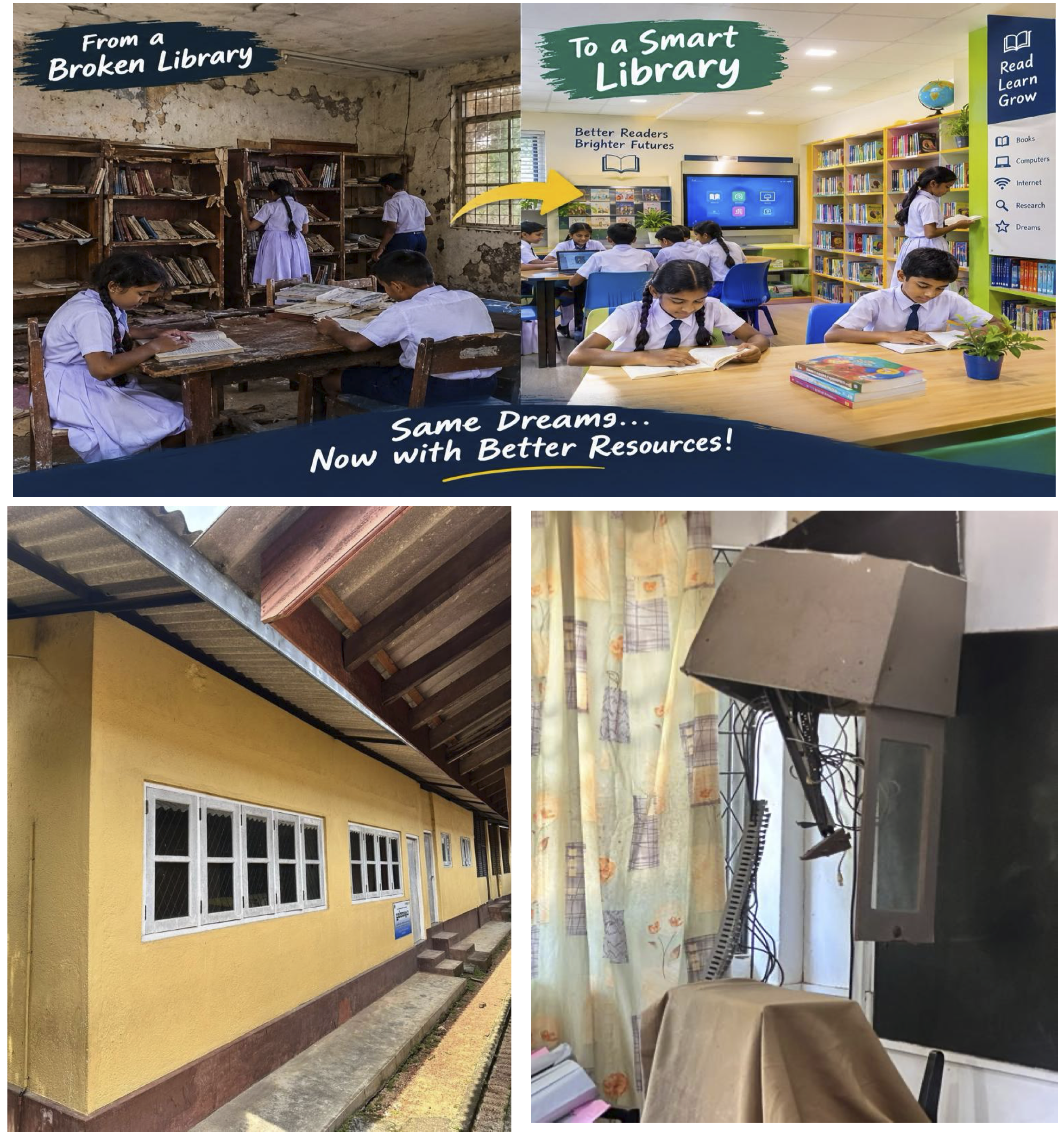
School/library facility image supplied for inclusion in the project proposal.
1. Project Background
The source proposal presents Project Hope as a school-library rebuilding and book-enrichment initiative.
Its stated goals are to improve structural safety, create an attractive and comfortable learning environment, enrich learning resources, foster reading habits, improve literacy, and support students’ academic performance.
The original proposal identifies the project location as a school library in Ragama, with the specific school name to be confirmed. The beneficiaries include primary and secondary students, teaching staff, and members of the local community.
2. SMART Project Framework
Specific
Rebuild and renovate the existing school library; improve the roof, walls, flooring, ceiling, electrical and lighting systems, and finishes; provide suitable furniture; and add curriculum-relevant, age-appropriate books and learning resources.
Measurable
Complete the defined renovation works, install the planned furniture, establish an organised library and catalogue system, and procure the planned books and learning resources. Completion will be recorded through an itemised handover checklist.
Achievable
Implement the project through phased approvals, procurement, civil construction, interior and equipment installation, resource organisation, and handover. Lions Club members and school staff will jointly oversee implementation and ongoing maintenance.
Relevant
The project directly supports safer learning facilities, a better reading environment, literacy development, reading habits, and academic support for students.
Time-Bound
Proposed planning target: Complete implementation within 12 weeks from formal approval and site handover.
This 12-week target is a proposed SMART planning enhancement and should be confirmed following the structural survey, procurement process, and required school approvals.
3. Key Objectives
● Structural Renovation
Rebuild and renovate the existing library to ensure long-term structural integrity and safety.
● Enhanced Learning Environment
Create an attractive, modern, and comfortable reading space with ergonomic seating and appropriate lighting.
● Resource Enrichment
Procure and develop a diverse collection of curriculum-relevant, age-appropriate books, reference materials, and educational resources.
● Academic Development
Foster reading habits, improve literacy levels, and support the overall academic performance of students.
4. Proposed Implementation Plan
| Phase | Main Activities | Indicative Timing* |
|---|---|---|
| 1. Approvals & Survey | School confirmation, approvals, site and structural survey, final scope and measurements | Weeks 1–2 |
| 2. Procurement | Supplier quotations; procurement of construction materials, furniture, books, and learning resources | Weeks 2–4 |
| 3. Civil Construction | Demolition/site preparation, rebuilding, walls, flooring, plastering, roof, and ceiling works | Weeks 4–8 |
| 4. Interior & Equipment | Electrical and lighting works, painting and finishing, furniture installation, and reading-space setup | Weeks 8–10 |
| 5. Resource Organisation | Library organisation, catalogue setup, book arrangement, and preparation of learning resources | Weeks 10–11 |
| 6. Handover & Orientation | Final inspection, correction of outstanding defects, handover, and orientation for school staff and users | Week 12 |
*The source proposal provides the sequence of phases but does not specify the duration of each phase. The 12-week schedule is therefore a proposed SMART planning schedule.
5. Budget
| No. | Item | Estimated Cost (LKR) |
|---|---|---|
| 1 | Demolition & Site Preparation | 200,000 |
| 2 | Civil Works (Rebuilding, Walls, Flooring, Plastering) | 850,000 |
| 3 | Roof Repairs & Ceiling Installation | 400,000 |
| 4 | Electrical Works & Lighting Systems | 200,000 |
| 5 | Painting & Finishing (Interior & Exterior) | 250,000 |
| 6 | Furniture (Shelves, Tables, Chairs, Soft Seating) | 400,000 |
| 7 | Books & Learning Resources Procurement | 1,000,000 |
| 8 | Library Organisation & Catalogue Setup | 120,000 |
| 9 | Miscellaneous & Contingencies (5%) | 150,000 |
| TOTAL | 2,570,000 |
Budget Note
The source proposal states that these costs are preliminary estimates and are subject to adjustment based on the final structural survey and supplier quotations.
6. Monitoring & Success Indicators
● 100% of approved renovation work items completed and verified before handover.
● Library furniture installed and ready for use in the completed reading area.
● Procurement of books and learning resources completed against an approved list and documented at handover.
● Library organisation and catalogue setup completed before the library opens for regular use.
● Final inspection completed with a documented defects and rectification checklist.
● A joint Lions Club–school management arrangement established for ongoing maintenance.
● An annual book drive initiated to refresh and expand the collection, as proposed in the source document.
7. Sustainability
The source proposal recommends establishing a joint management committee comprising Lions Club members and school staff to oversee the ongoing maintenance of the library facility.
It also recommends an annual book drive to continuously refresh and expand the library collection.
These measures are retained as the project's core sustainability mechanism.
8. Expected Impact
Upon completion, the project is expected to provide a safer, more attractive, comfortable, and better-equipped library environment for students.
It will improve access to books and learning resources, encourage reading, strengthen literacy, and support students’ academic development and overall educational performance.
This document has been prepared as a SMART-format enhancement of the supplied Project Hope proposal. The original budget and project objectives have been retained, while the SMART measures and 12-week planning target have been introduced as proposed planning enhancements.
Fundraising Projects for Sri Lanka
This initiative invites Sri Lankans, the Sri Lankan diaspora, and friends of Sri Lanka worldwide to organise fundraising projects that support sustainable development and help strengthen Sri Lanka's economy.
You can create your own fundraising project and choose the town, village, or community in Sri Lanka that you wish to support.
How to Participate
Before launching your fundraiser, please submit the following information to Mankind Sweden NGO. If you are in Sri Lanka, contact the Lions Club of Ragama Legends, who will connect you with our local coordinators.
- Project name
- Purpose and objectives
- Fundraising location
- Campaign dates
- Planned use of funds
- The town, village, or community you wish to support
Transparency
To ensure accountability:
- All donations must be managed through the Lions Club of Ragama Legends or another approved charitable organisation.
- Cash donations are not permitted.
- All funds must be transferred through official banking channels.
Fundraising Expenses
Reasonable fundraising expenses may be reimbursed with valid receipts, including transport, travel, meals, accommodation, venue hire, advertising, promotional materials, equipment hire, and other approved costs.
Fundraising expenses are limited to 10% of the total amount raised.
Fund Allocation
- 85% – Community development projects in Sri Lanka.
- Up to 10% – Approved fundraising expenses.
- Up to 5% – Administration, project management, monitoring, marketing, travel, accommodation, and operational costs in Sri Lanka and abroad.
This funding model ensures maximum transparency, accountability, and impact for every donation.